Banana fiber suppliers: start with the product form
Buying banana fiber for a processor is a different project from buying cloth for a clothing brand. Start by deciding who will handle the next manufacturing stage, then ask suppliers for the exact form and specification they offer.
This guide separates published product offers from questions that still need a direct answer. A website review does not confirm available stock, factory capability or order acceptance.
Website research reviewed October 5, 2026; The Banana Fiber Company’s availability rechecked October 7, 2026. ECOFITEXT’s public profile, earlier company correspondence and undated pitch deck were reviewed November 3, 2026. Current supply has not been reconfirmed, and we have not tested samples.
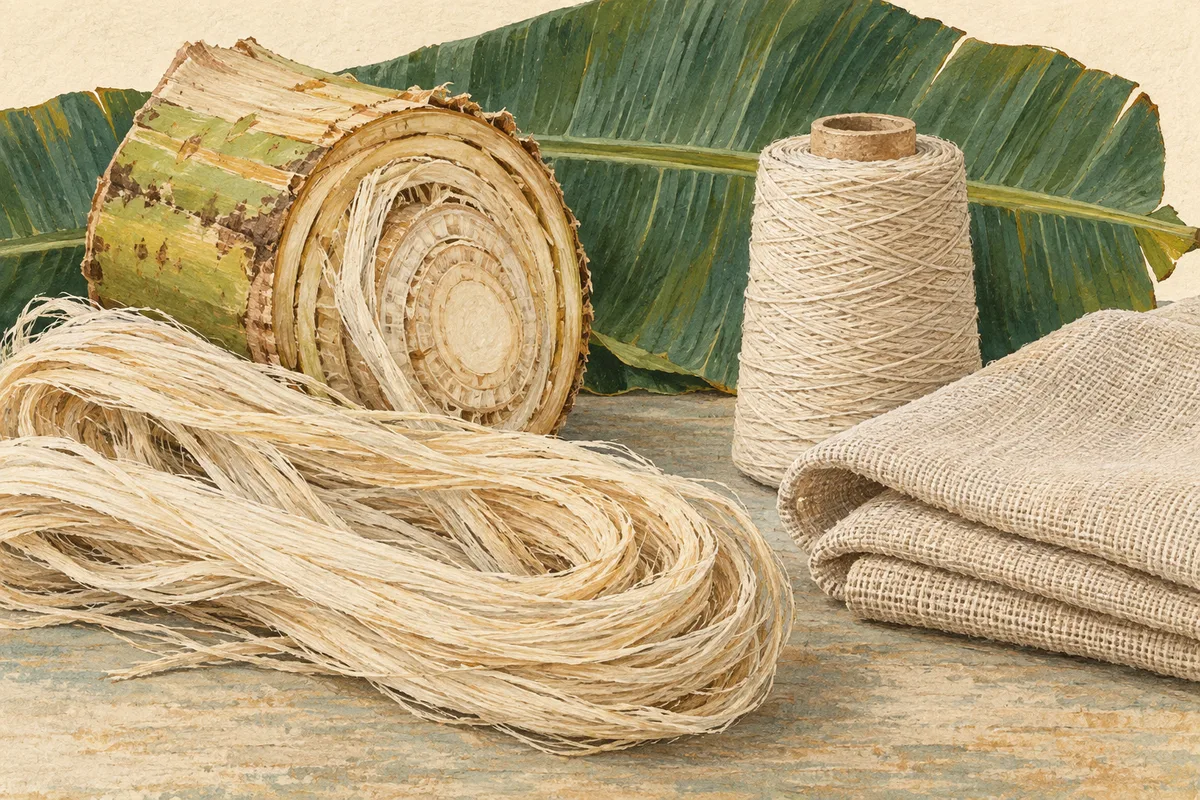
AI-created editorial illustration of material stages; not a photograph of a supplier or a technical process diagram.
Compare banana suppliers
Match the product form to your project before comparing quantities. These starting points draw on public company information and, where noted, company replies. Check each profile for source dates and what was confirmed; current stock and order acceptance still need a direct answer.
| Supplier | Product offered or described | Order starting point | Source and date |
|---|---|---|---|
| ECOFITEXT | Banana-stem fiber input; current grades and availability to confirm | An undated company pitch deck lists a 5 kg starter pack and larger packs. This is not a confirmed current minimum order or stock offer. Request current sample sizes, minimums, capacity, lead times and export terms. | Company profile reviewed · Prior direct contact |
| BanFab | Banana-fiber blend yarns and fabrics | Not published on the reviewed pages. Request minimums by yarn count, construction, color and finishing requirement. | Website reviewed |
| The Banana Fiber Company | Planned banana-fiber inputs; product enquiries not yet open | Not currently open to product enquiries, according to the main website. No numerical minimum confirmed. | Website reviewed |
Properties
- Fiber inputs: ask about preparation, length, moisture, cleanliness and any treatment.
- Yarn: request count, twist, full blend percentages and a sample your mill can evaluate.
- Fabric: confirm construction, weight, usable width, finish and care requirements.
Applications
- For clothing, begin with suitable fabric unless your team can manage spinning or weaving.
- For a textile-development project, agree the input specification with the processor first.
- Paper, craft and textile inputs are not interchangeable simply because they share a plant source.
Sustainability
- Ask where the feedstock comes from and how it is processed.
- Request product-specific evidence for environmental or performance claims.
- Check blend fibers, dyes, coatings and trims before making end-of-life claims.
- An agricultural-residue input does not establish zero-waste production.
Before you request a quote
Check the buying stage
BanFab’s website describes banana-fiber yarns and fabrics. That gives you a starting point for a yarn or fabric enquiry, not a confirmed stock list. Request the specific blend, available construction and minimum per color before arranging production.
The Banana Fiber Company is a project to watch: its main website currently says it is in pre-launch and is not accepting product enquiries. Its separate textile page describes planned inputs, but does not establish that these are available to order.
ECOFITEXT in Burundi describes extracting fiber from banana stems and supplying other manufacturers. Its undated pitch deck lists a 5 kg starter pack, but current availability, specifications and order terms need confirmation. Treat it as a fiber-input enquiry, not a confirmed source of ready-to-cut fabric.
“Banana” does not mean cotton-free
An older Circular Fiber Tech brochure describes a yarn containing 60% banana fiber and 40% organic cotton. This is an example of why the complete composition matters, not a current offer or quotation. Ask for percentages for the exact item, including any alternative blend being proposed.
Ask whether the material is abacá
Some textile offers use abacá: PYRATEX identifies its musa family with abacá fiber, from a banana species native to the Philippines. Confirm the plant source and product identity rather than assuming every banana-labelled textile uses the same feedstock or process.
Prepare a useful enquiry
- Specify fiber, yarn or fabric and the intended end product.
- State excluded ingredients and request the full composition.
- Give sample and production quantities with units and a delivery destination.
- Ask for the minimum per specification, sample cost, lead time and repeat-order terms.
- Have your manufacturing partner evaluate the sample before committing to a larger order.
Use our supplier quote checklist to compare replies. For ready-to-cut hemp or linen instead, explore the small-order fabric guide.
Editorial correction: this page previously made broad zero-waste, durability and biodegradability claims without product-specific evidence. Those claims have been removed. How we check information.